
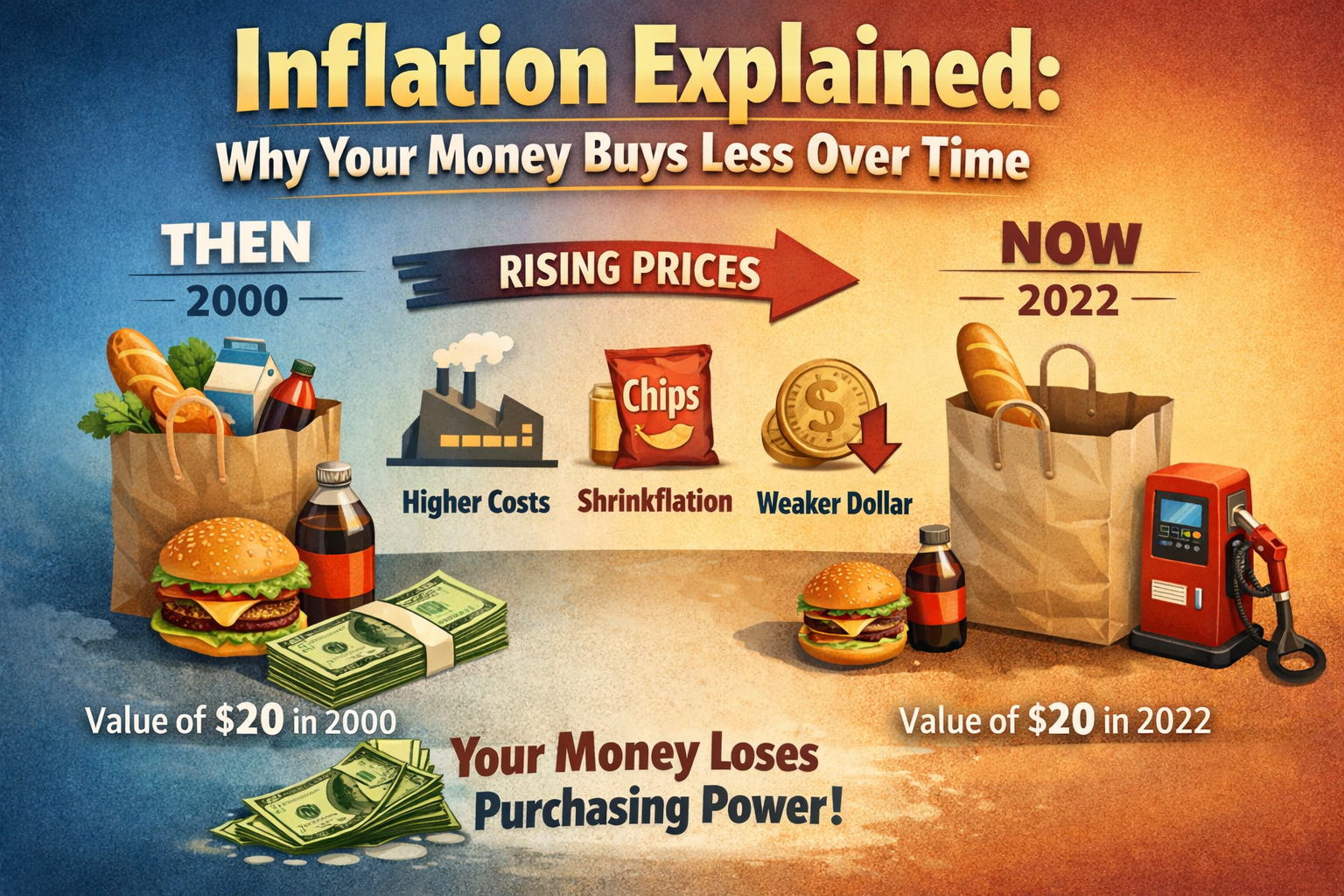
Inflation explained in simple terms. Learn what causes inflation, how it affects your money, and practical ways to protect your finances from rising prices.
Introduction
Have you ever noticed that the same grocery bill that used to cost ₹2,000 a few years ago now easily crosses ₹3,000? Or that a cup of coffee, movie ticket, or even rent seems to get more expensive every year?
That’s inflation at work.
Inflation is one of the most important forces shaping the global economy, yet most people only feel its effects without fully understanding what’s going on behind the scenes. Whether you’re saving money, investing, running a business, or just trying to manage household expenses, inflation quietly influences your financial life.
In simple terms, inflation is the gradual rise in the price of goods and services over time, which means your money slowly loses purchasing power.
But inflation isn’t always bad. In fact, a moderate level of inflation is considered healthy for an economy. The real problem begins when inflation rises too quickly or remains high for long periods.
In this guide, we’ll break down what inflation really means, why it happens, how it affects your money, and most importantly — how you can protect your finances from rising prices.
What Is Inflation?
Inflation refers to the rate at which the general price level of goods and services increases over time.
As prices rise, the purchasing power of money declines.
For example:
- If inflation is 5%, something that costs ₹100 today may cost ₹105 next year.
- Your money doesn’t disappear — it simply buys less than before.
Economists measure inflation using price indexes such as the Consumer Price Index (CPI), which tracks the cost of common household items.
You can learn more about CPI from the official explanation provided by the International Monetary Fund:
https://www.imf.org/en/Publications/fandd/issues/Series/Back-to-Basics/Inflation
Why Inflation Happens
Inflation doesn’t appear randomly. It usually happens due to a mix of economic forces. Let’s look at the most common causes.
1. Demand-Pull Inflation
This happens when demand for goods and services grows faster than supply.
When more people want to buy something than the market can produce, prices naturally rise.
Example:
- Economic growth increases consumer spending
- Businesses struggle to keep up with demand
- Prices climb
A classic example occurred during post-pandicip recovery periods when global demand surged.
2. Cost-Push Inflation
This type of inflation happens when production costs increase, forcing businesses to raise prices.
Common cost drivers include:
- Higher wages
- Rising fuel prices
- Increased raw material costs
- Supply chain disruptions
For example, when global oil prices rise, transportation costs increase — which then affects the price of food, electronics, and many other products.
3. Monetary Inflation
Sometimes inflation happens because too much money is circulating in the economy.
When central banks increase the money supply aggressively, purchasing power rises quickly, which can push prices upward.
Central banks like the Federal Reserve or Reserve Bank of India often adjust interest rates to manage inflation.
A detailed explanation can also be found here:
https://en.wikipedia.org/wiki/Inflation
How Inflation Affects Everyday Life
Inflation touches almost every aspect of personal finance.
Some effects are obvious, while others are subtle but powerful.
1. Rising Cost of Living
One of the most visible effects of inflation is the increase in everyday expenses.
Things affected include:
- Groceries
- Housing
- Transportation
- Healthcare
- Education
When wages fail to keep pace with inflation, households feel financial pressure.
2. Reduced Purchasing Power
Inflation slowly reduces the value of your savings.
For example:
- ₹1,00,000 saved today
- If inflation averages 6% annually
- After 10 years, its real purchasing value drops significantly
This is why simply keeping money in cash can be risky over long periods.
3. Impact on Investments
Inflation influences different investments in different ways.
Some assets perform well during inflation, while others struggle.
Assets that may benefit from inflation:
- Stocks
- Real estate
- Commodities
- Inflation-protected bonds
Assets that may lose value during inflation:
- Cash savings
- Fixed-income investments with low interest rates
Understanding this relationship is key for long-term financial planning.
How Governments Control Inflation
Managing inflation is one of the primary responsibilities of central banks.
They typically use monetary policy tools to maintain price stability.
1. Interest Rate Adjustments
When inflation rises too quickly, central banks may increase interest rates.
Higher rates lead to:
- Reduced borrowing
- Lower consumer spending
- Slower economic growth
- Stabilized prices
2. Controlling Money Supply
Central banks can reduce inflation by limiting the amount of money circulating in the economy.
This helps control excessive demand.
3. Fiscal Policies
Governments may also use tax policies and public spending adjustments to influence inflation.
However, fiscal tools are generally slower compared to monetary policy changes.
Types of Inflation
Not all inflation behaves the same way. Economists categorize inflation based on its severity.
1. Creeping Inflation
- Mild inflation
- Usually 1–3% annually
- Considered healthy for economic growth
2. Walking Inflation
- Moderate inflation
- Prices rise 3–10% annually
- Can start affecting savings and spending behavior
3. Galloping Inflation
- Rapid price increases
- Often 10–20% or higher
- Can destabilize economies
4. Hyperinflation
This is the extreme scenario.
Prices increase uncontrollably, sometimes thousands of percent annually.
Historical examples include Zimbabwe and Venezuela, where currencies lost almost all value.
Smart Ways to Protect Your Money From Inflation
While inflation is unavoidable, there are practical strategies to reduce its impact.
1. Invest Instead of Hoarding Cash
Long-term investments tend to outpace inflation.
Examples include:
- Stock market index funds
- Mutual funds
- Real estate
- Retirement accounts
Historically, equities have delivered returns higher than inflation over long periods.
2. Diversify Your Portfolio
A diversified portfolio spreads risk across different asset classes.
Typical diversification may include:
- Stocks
- Bonds
- Real estate
- Gold or commodities
This helps protect wealth when one asset class underperforms.
3. Increase Your Income Potential
Inflation hits hardest when income stays stagnant.
Ways to counter this include:
- Developing high-demand skills
- Negotiating salary increases
- Starting side income streams
Financial resilience often comes from earning more, not just saving more.
4. Track Your Spending
Inflation can quietly increase your monthly expenses.
Simple habits can help control this:
- Budget tracking
- Reviewing subscriptions
- Comparing prices
- Avoiding impulse purchases
Small adjustments can offset inflation’s effects.
Inflation and the Global Economy
Inflation isn’t limited to one country — it’s a global economic phenomenon.
Factors influencing global inflation include:
- Energy prices
- Supply chain disruptions
- Geopolitical conflicts
- Global demand trends
- Currency fluctuations
For example, rising oil prices can push inflation higher across multiple countries simultaneously.
This interconnected system means economic policies in one region can influence inflation worldwide.
Conclusion
Inflation is an unavoidable part of modern economies. It slowly changes how much your money can buy, shaping everything from grocery prices to investment returns.
While rising prices can feel frustrating, understanding how inflation works gives you a powerful advantage.
By investing wisely, diversifying assets, and staying financially aware, you can reduce inflation’s impact and even use it to your advantage over the long term.
The key isn’t trying to eliminate inflation — that’s impossible. The real goal is building a financial strategy that grows faster than inflation itself.
Frequently Asked Questions (FAQ)
What is inflation in simple terms?
Inflation is the gradual increase in the prices of goods and services over time, which reduces the purchasing power of money.
What causes inflation?
Inflation can be caused by several factors, including increased consumer demand, higher production costs, and expansion of the money supply by central banks.
Is inflation good or bad?
Moderate inflation is generally considered healthy for economic growth. However, high or unpredictable inflation can harm savings, investments, and economic stability.
How does inflation affect savings?
Inflation reduces the real value of savings over time. If your savings grow slower than the inflation rate, your purchasing power declines.
Which investments protect against inflation?
Investments that historically perform well during inflation include stocks, real estate, commodities, and inflation-protected securities.
Can inflation be controlled?
Yes. Central banks attempt to control inflation by adjusting interest rates, regulating the money supply, and implementing monetary policies aimed at stabilizing prices.
