
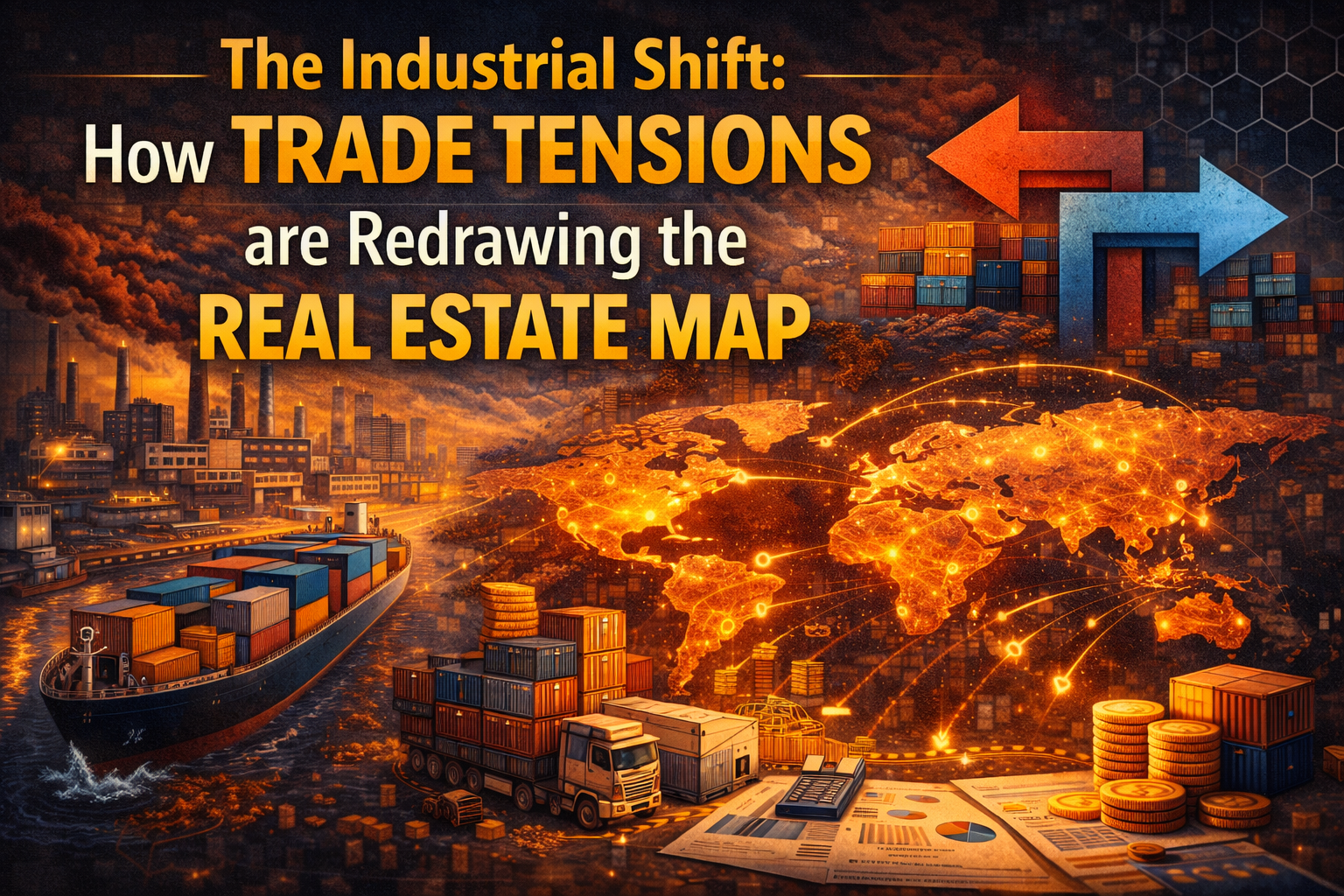
Trade wars are reshaping real estate. Discover how Global Supply Chain Finance is shifting industrial property demand and creating new investor opportunities.
I was touring a massive, half-finished distribution center in Texas last month with a client named David. He’s a veteran developer who usually builds these projects in his sleep. But this time, he looked stressed. The steel he ordered from overseas was delayed again, and his primary tenant—a major electronics manufacturer—was threatening to pull out because their own credit lines were frozen amid new international tariffs.
“The dirt is the easy part,” David told me, kicking a piece of rebar. “Following the money across borders right now is a nightmare.”
He was colliding head-first with a massive macroeconomic shift. The plumbing of international trade is clogging up. If you own or invest in physical buildings, you need to understand how Global Supply Chain Finance is reacting to rising trade tensions, because it directly dictates who rents your buildings and what they can afford to pay.
What is Global Supply Chain Finance?
To understand how this impacts commercial real estate, we have to define the underlying mechanics. In plain English, Global Supply Chain Finance is a set of tech-based business and financing processes that lower costs and improve efficiency for buyers and sellers in a sales transaction.
Basically, it’s the short-term credit that allows a factory in Vietnam to buy raw materials, build a product, and ship it to a warehouse space in California before the American buyer actually pays the invoice.
When trade relations are friendly, this money flows like water. But when tariffs hit and geopolitical arguments flare up, lenders get extremely nervous. They pull back. And when the money stops flowing, corporations suddenly have to rethink their entire physical footprint.
The Retreat to “Nearshoring” and Logistics Hubs
We are watching a massive unwinding of globalization. As trade wars escalate between the US, China, and Europe, companies are realizing that having their manufacturing ten thousand miles away is far too risky.
Because lenders involved in Global Supply Chain Finance are charging higher premiums for risky, long-distance trade routes, corporations are relocating. They are aggressively pulling operations out of Asia and moving them to Mexico, Canada, or domestic markets like the American Midwest.
This trend, known as nearshoring, is creating a tidal wave of tenant demand for industrial properties across North America. If a company moves its manufacturing to Monterrey, Mexico, they suddenly need millions of square feet of distribution centers in Texas and Arizona to handle the massive influx of goods crossing the border.
How Real Estate Investors Can Follow the Money
Smart real estate investors don’t just look at traffic counts or population growth; they look at where the corporate capital is flowing. If you want to know which asset classes are going to boom next, watch the lenders.
Institutions providing Global Supply Chain Finance are heavily incentivizing companies to build redundant, localized supply chains. This means instead of leasing one massive mega-warehouse on the coast, companies are leasing three or four smaller regional facilities inland.
- The “Just-in-Case” Model: We are shifting from “just-in-time” inventory to “just-in-case.” Retailers are hoarding inventory to avoid stock shortages.
- Higher Property Values: This hoarding requires significantly more square footage. That relentless demand is pushing up property values for Class B and Class C industrial spaces that institutional buyers used to ignore.
- Stable Rental Yields: Companies cannot afford to lose their spot in a fractured supply chain. Once they sign long-term commercial leases, they stay put, providing incredibly stable cash flow for landlords.
Link to CBRE: Global Industrial & Logistics Real Estate Insights
The Squeeze on Development and Cap Rates
Of course, it’s not all sunshine and rising rents. The disruption in Global Supply Chain Finance also makes it incredibly expensive to actually build new properties.
David, the developer I mentioned earlier, was facing this exact squeeze. The cost to finance the raw materials for construction has skyrocketed because international suppliers are facing their own credit crunches.
When the cost to build goes up, development slows down. This restricts the supply of new inventory hitting the market. For existing landlords, this is a massive win. Low supply and high corporate demand keep cap rates compressed and building values elevated. But for developers trying to get a project out of the ground, managing the hurdles of modern Global Supply Chain Finance requires an iron stomach and deep pockets.
The Technology Solution for Commercial Assets
To adapt to these rising trade tensions, the financial sector is aggressively turning to technology. Blockchain, AI, and smart contracts are slowly working their way into Global Supply Chain Finance.
How does this affect your brick-and-mortar investments? Traceability.
Modern tenants need their physical buildings to talk to their financial software. They want logistics hubs equipped with 5G, automated tracking, and high-tech inventory systems so they can prove to their lenders exactly where their collateral (the physical inventory) is at any given second. If you own an obsolete, tin-roof warehouse with terrible internet infrastructure, you are going to lose out on high-paying corporate tenants.
Link to Investopedia: Understanding Commercial Real Estate
Redrawing the Global Map
Trade tensions aren’t going away. In fact, most experts predict economic protectionism will define the next decade of commerce. As governments weaponize tariffs, the traditional models of funding overseas production are fundamentally breaking down. This is forcing a complete redesign of Global Supply Chain Finance.
For the real estate sector, this redesign is a massive catalyst for localized growth. The massive banks and tech companies that facilitate Global Supply Chain Finance are essentially dictating the new map of global trade. They decide which countries are too risky to lend to, and which regions are deemed safe harbors.
When you evaluate a new commercial property purchase today, you have to think like an international banker. Ask yourself: Is this location supported by the new, localized trade routes favored by Global Supply Chain Finance? If a region is cut off from these financial lifebloods due to geopolitical sanctions or shipping disputes, the physical real estate there will inevitably suffer.
FAQ Section
1. What is Global Supply Chain Finance? It is a financial strategy where a corporate buyer uses a third-party funder to pay their suppliers early, optimizing cash flow for both parties. In real estate, changes to Global Supply Chain Finance dictate where companies can afford to lease industrial spaces and build factories.
2. How do trade tensions affect commercial real estate? Trade tensions force companies to move their manufacturing and storage closer to their end consumers (nearshoring). This creates a massive surge in demand for domestic warehouse space, driving up rents in key logistics markets.
3. Why are industrial property values rising so fast? Because global supply chains are broken and unpredictable, companies are keeping much more inventory on hand just in case of delays. This requires significantly more physical space, driving up demand and values in the industrial sector.
4. Can Global Supply Chain Finance impact construction costs? Absolutely. When international trade credit tightens due to tariffs or political disputes, the cost of importing raw materials like steel, timber, and concrete rises sharply. This delays new developments and increases the overall cost of building.
Conclusion
The world is getting smaller, but the logistics of moving goods are getting infinitely more complicated. The days of seamless, ultra-cheap international shipping are fading, replaced by a fractured system of tariffs and political posturing.
As a property owner or investor, you cannot afford to ignore the macro environment. The evolution of Global Supply Chain Finance is redrawing the map of commercial real estate right in front of us. It is actively punishing obsolete, coastal import models and rewarding localized, tech-enabled distribution networks.
If you want to protect and grow your portfolio this decade, track where the corporate capital is flowing. By aligning your investments with the new realities of Global Supply Chain Finance, you can position yourself directly in the path of the next great industrial real estate boom.
Have you noticed a shift in industrial demand in your local market? Drop a comment below—I’d love to hear how these global trends are impacting your specific investments!
