Learn how financial markets work, including stocks, bonds, currencies, and commodities. A complete guide to understanding global financial markets and investing.
Introduction
Almost every major financial decision in the world connects back to financial markets in some way.
When companies raise money to expand, when governments issue bonds to fund projects, or when investors buy shares hoping their value will rise — all of these activities happen inside financial markets.
Even if you’ve never traded a stock yourself, financial markets still influence your daily life. Mortgage rates, retirement funds, currency exchange rates, and even the price of fuel are affected by what happens in these markets.
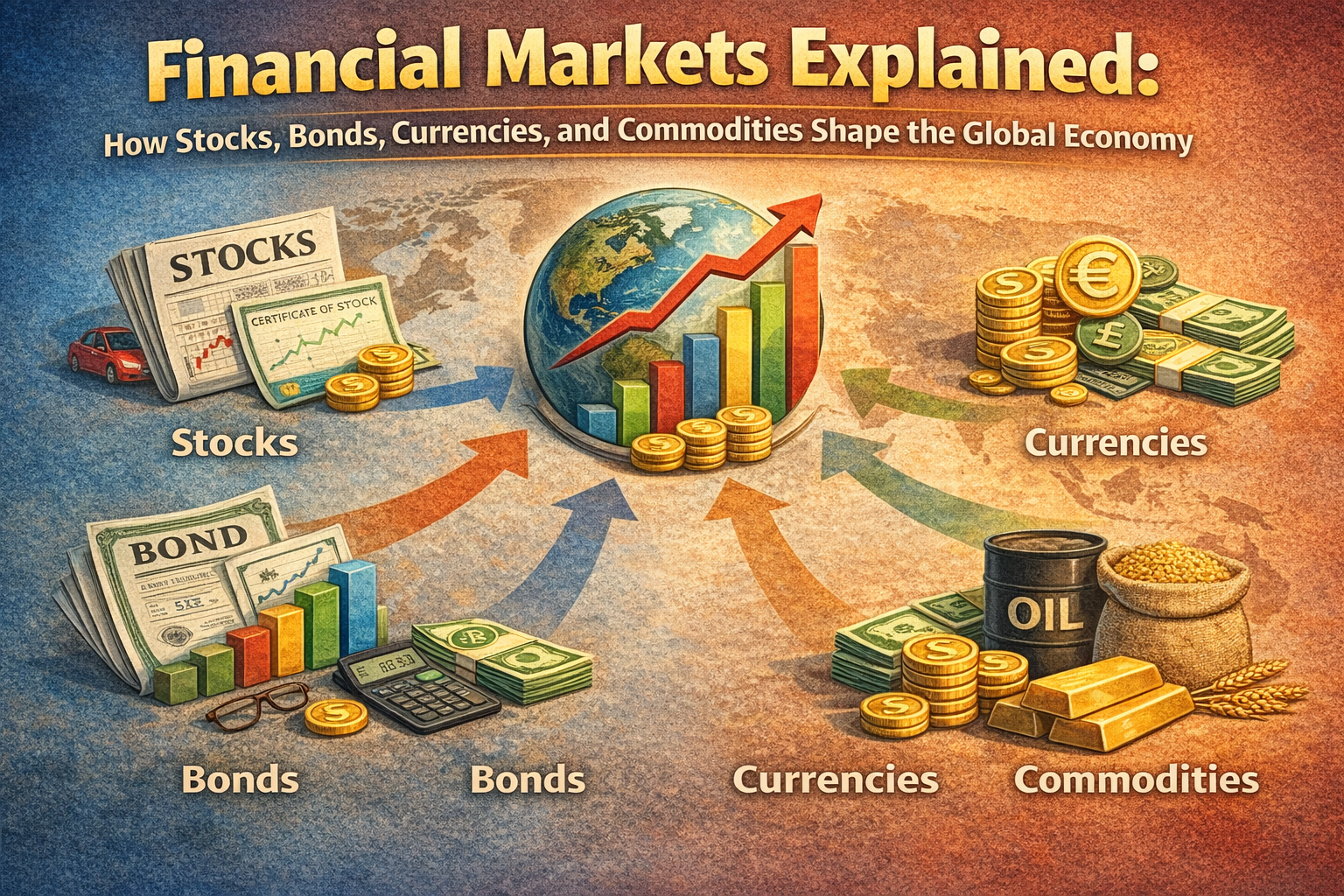
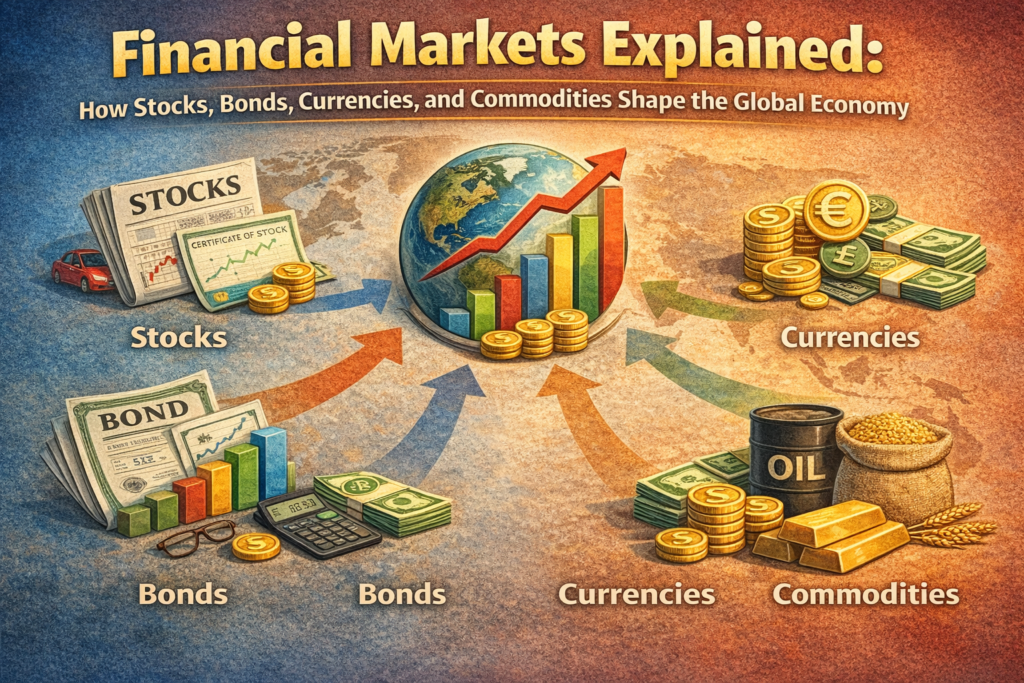
Financial markets are platforms where assets such as stocks, bonds, currencies, and commodities are bought and sold. They connect investors, businesses, and governments, allowing money to flow where it’s needed most.
Understanding how financial markets operate doesn’t require a finance degree. Once you grasp the basic structure, the system becomes much easier to follow.
Let’s break down how financial markets work, why they matter, and how they influence the global economy.
What Are Financial Markets?
At a basic level, financial markets are places where buyers and sellers trade financial assets.
These assets may include:
- Stocks (company ownership)
- Bonds (debt instruments)
- Currencies (foreign exchange)
- Commodities (raw materials like gold or oil)
- Derivatives and other financial instruments
Financial markets create a system where money can move efficiently between investors and organizations that need funding.
For a general overview of how these markets function, you can explore this resource:
https://en.wikipedia.org/wiki/Financial_market
Why Financial Markets Are Important
Financial markets play a critical role in the modern economy.
They serve several essential purposes.
1. Capital Formation
Businesses often need large amounts of money to grow.
Financial markets allow companies to raise capital by selling shares or issuing bonds.
This funding supports activities like:
- Expanding operations
- Developing new products
- Hiring employees
- Entering new markets
Without financial markets, many companies would struggle to access funding.
2. Investment Opportunities
Financial markets provide individuals and institutions with ways to grow wealth.
Investors can allocate funds into different assets such as:
- Stocks for long-term growth
- Bonds for income and stability
- Commodities for diversification
- Foreign currencies for global trade
These investment opportunities help individuals build savings and retirement portfolios.
3. Price Discovery
Markets constantly adjust prices based on supply and demand.
This process is called price discovery.
For example:
- A company reporting strong earnings may see its stock price rise.
- Rising demand for oil can push commodity prices higher.
Financial markets reflect real-time economic information.
4. Liquidity
Liquidity refers to how easily assets can be bought or sold without significantly affecting their price.
Highly liquid markets allow investors to enter and exit positions quickly.
Stock exchanges and currency markets are among the most liquid financial systems in the world.
Types of Financial Markets
Financial markets are not a single entity. They consist of several specialized markets, each serving a different purpose.
Stock Markets
The stock market is where shares of publicly traded companies are bought and sold.
When you purchase a stock, you’re essentially buying a small ownership stake in a company.
Well-known stock exchanges include:
- New York Stock Exchange (NYSE)
- NASDAQ
- London Stock Exchange
- National Stock Exchange of India
Companies list their shares to raise funds from investors.
In return, investors may benefit from:
- Capital appreciation
- Dividend payments
Bond Markets
Bond markets allow governments and corporations to borrow money from investors.
A bond is essentially a loan made by an investor to a borrower.
In return, the borrower pays:
- Periodic interest payments
- The principal amount at maturity
Bond markets are often considered more stable than stock markets.
Governments frequently issue bonds to finance infrastructure projects or public spending.
You can learn more about bonds here:
https://en.wikipedia.org/wiki/Bond_(finance)
Foreign Exchange (Forex) Markets
The foreign exchange market is where global currencies are traded.
This is the largest financial market in the world.
Currencies are traded in pairs such as:
- USD/INR
- EUR/USD
- GBP/JPY
Forex markets operate 24 hours a day due to international time zones.
They play a crucial role in international trade, tourism, and global investment.
Commodity Markets
Commodity markets involve trading physical goods such as:
- Gold
- Silver
- Oil
- Natural gas
- Agricultural products
These markets allow producers and buyers to manage price risks.
For example, airlines often hedge fuel costs through commodity markets.
Derivatives Markets
Derivatives are financial contracts whose value depends on underlying assets.
Examples include:
- Futures contracts
- Options contracts
- Swaps
These instruments are commonly used for risk management and hedging strategies.
Although derivatives can be complex, they play an important role in stabilizing financial systems.
Who Participates in Financial Markets?
Financial markets involve a wide range of participants.
Each group plays a unique role in maintaining market activity.
Individual Investors
These are everyday people investing through brokerage accounts or retirement funds.
They typically invest in stocks, mutual funds, or ETFs.
Institutional Investors
Large organizations invest massive amounts of capital.
Examples include:
- Pension funds
- Insurance companies
- Hedge funds
- Mutual fund companies
Institutional investors often influence market movements due to the scale of their investments.
Governments and Central Banks
Governments issue bonds and manage currency reserves.
Central banks may intervene in financial markets to stabilize currencies or control inflation.
Corporations
Companies use financial markets to raise capital through stock offerings and bond issuance.
How Technology Has Changed Financial Markets
Financial markets have evolved dramatically with the rise of technology.
A few decades ago, trading happened on physical exchange floors.
Today, most transactions occur electronically.
Key technological changes include:
- Online trading platforms
- High-frequency trading algorithms
- Real-time market data
- Mobile investment apps
Technology has made investing more accessible to everyday individuals.
Retail investors can now trade global assets from their smartphones.
Risks in Financial Markets
While financial markets offer opportunities for growth, they also carry risks.
Common risks include:
Market Volatility
Asset prices can fluctuate significantly due to economic news, geopolitical events, or investor sentiment.
Economic Uncertainty
Recessions, inflation, and interest rate changes can impact financial markets.
Liquidity Risk
Some assets may become difficult to sell during market downturns.
Behavioral Biases
Emotions like fear and greed often lead investors to make poor decisions.
Understanding these risks is essential for long-term investing success.
Real-Life Example of Financial Markets at Work
Consider a technology company planning to expand globally.
To fund its expansion, the company may issue new shares on the stock market.
Investors purchase those shares, providing capital for the company.
Meanwhile:
- Bond investors may fund infrastructure projects
- Currency markets facilitate international transactions
- Commodity markets determine the cost of raw materials
All these activities occur within interconnected financial markets.
Conclusion
Financial markets are the backbone of the global financial system.
They connect investors with businesses, governments, and institutions that need funding. Through the trading of stocks, bonds, currencies, and commodities, these markets allow capital to flow efficiently across the economy.
While they can appear complex at first glance, their basic purpose is simple: match those who have money with those who need it.
By understanding how financial markets work, investors and individuals can make more informed decisions about saving, investing, and managing risk.
Whether you’re planning for retirement, investing in stocks, or simply following economic news, financial markets shape the financial landscape we all live in.
Frequently Asked Questions (FAQ)
What are financial markets?
Financial markets are platforms where assets such as stocks, bonds, currencies, and commodities are traded between buyers and sellers.
Why are financial markets important?
They help businesses raise capital, provide investment opportunities, facilitate price discovery, and support economic growth.
What are the main types of financial markets?
The main types include stock markets, bond markets, foreign exchange markets, commodity markets, and derivatives markets.
Who participates in financial markets?
Participants include individual investors, institutional investors, corporations, governments, and central banks.
How do financial markets affect the economy?
Financial markets influence interest rates, investment activity, currency values, and overall economic growth.
Are financial markets risky?
Yes. Financial markets involve risks such as volatility, economic uncertainty, and liquidity issues, which is why diversification and long-term strategies are important.
