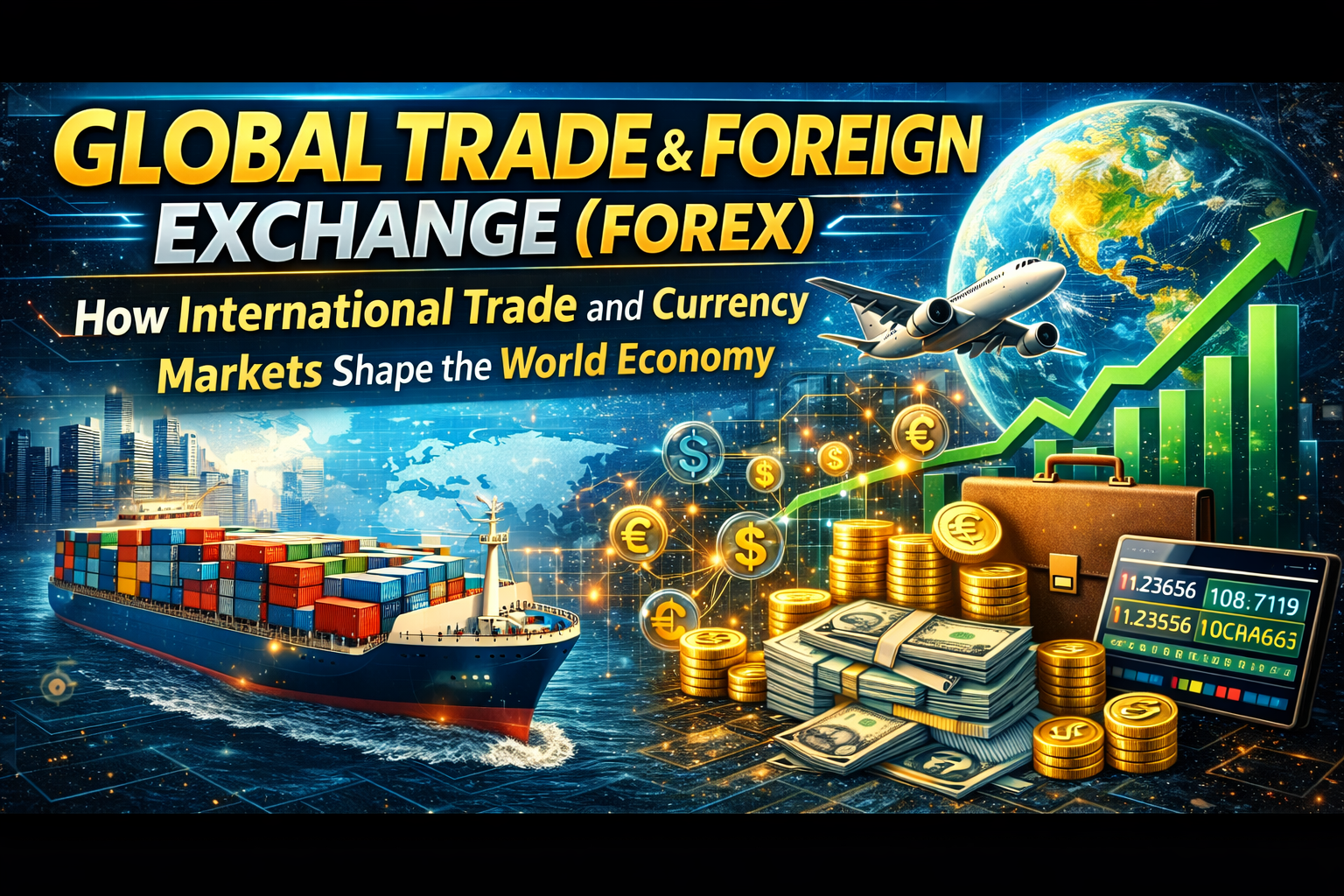
Learn how Global Trade and Foreign Exchange (Forex) drive international commerce, currency exchange, and global financial markets.
Introduction
Every time a country imports oil, exports electronics, or sells agricultural products overseas, a financial transaction happens behind the scenes. Those transactions require currencies to be exchanged, payments to be settled, and prices to be adjusted across borders.
That’s where Global Trade and Foreign Exchange (Forex) come into play.
International trade connects economies by allowing countries to buy and sell goods and services globally. Meanwhile, the foreign exchange market ensures that currencies can be converted efficiently to support those transactions.
Without the Forex market, global commerce would slow dramatically. Companies wouldn’t be able to pay suppliers abroad, tourists couldn’t easily spend money overseas, and investors would struggle to move capital across countries.
Understanding Global Trade and Foreign Exchange (Forex) provides insight into how modern economies interact, how currencies fluctuate, and why international markets matter for businesses and investors alike.
What Is Global Trade and Foreign Exchange (Forex)?
Global Trade and Foreign Exchange (Forex) refers to the system that enables countries, businesses, and investors to exchange currencies while conducting international trade.
Global trade involves the import and export of goods and services between countries. Since each nation typically uses its own currency, these transactions require currency conversion.
The Forex market is where that conversion takes place.
The foreign exchange market is the largest financial market in the world, with trillions of dollars traded daily.
You can explore the fundamentals of the forex market here:
https://en.wikipedia.org/wiki/Foreign_exchange_market
How Global Trade Drives Currency Exchange
Every international transaction requires at least two currencies.
For example:
- A U.S. company importing machinery from Germany must convert dollars into euros.
- A Japanese company buying oil from the Middle East might convert yen into U.S. dollars.
- A British retailer purchasing products from China may exchange pounds for yuan.
These exchanges occur in the Forex market, where currencies are traded in pairs such as:
- EUR/USD
- USD/JPY
- GBP/USD
The constant demand for currency exchange is what keeps the Forex market active 24 hours a day.
The Importance of the Forex Market
The Foreign Exchange market plays a crucial role in supporting international commerce.
Facilitating Global Trade
Businesses rely on Forex markets to pay international suppliers and receive payments from foreign customers.
Enabling Investment Across Borders
Investors often purchase foreign stocks, bonds, or assets, which requires currency conversion.
Stabilizing Currency Values
Continuous trading helps determine fair market exchange rates.
Supporting Tourism and Travel
Travelers exchange currencies when visiting other countries, contributing to the Forex market.
Without this global system, international trade would become significantly more complex and expensive.
Key Participants in the Forex Market
The Forex market operates through a network of financial institutions, businesses, and investors.
Central Banks
Central banks influence currency values through monetary policy and interest rate decisions.
Examples include:
- The U.S. Federal Reserve
- The European Central Bank
- The Bank of Japan
These institutions sometimes intervene in currency markets to stabilize their economies.
Commercial Banks
Banks handle most currency transactions for businesses and individuals.
Multinational Corporations
Companies involved in global trade regularly exchange currencies to manage international payments.
Institutional Investors
Hedge funds, asset managers, and investment firms trade currencies for both hedging and speculation.
Retail Forex Traders
Individual traders also participate in the Forex market through online trading platforms.
How Currency Exchange Rates Work
An exchange rate determines how much one currency is worth relative to another.
For example:
- 1 USD = 0.92 EUR
- 1 GBP = 1.27 USD
Exchange rates fluctuate constantly due to market supply and demand.
Several factors influence currency values:
- Interest rates
- Inflation
- Economic growth
- Political stability
- Trade balances
When a country exports more than it imports, demand for its currency often increases.
More information on exchange rate systems can be found here:
https://www.investopedia.com/terms/e/exchangerate.asp
Types of Forex Markets
The foreign exchange market operates through different trading environments.
Spot Market
The spot market involves immediate currency transactions at the current market price.
Forward Market
Forward contracts allow businesses to lock in exchange rates for future transactions.
Futures Market
Currency futures are standardized contracts traded on financial exchanges.
These instruments help businesses manage currency risk when dealing with international payments.
Real-Life Example of Forex in Global Trade
Imagine a car manufacturer in Japan exporting vehicles to the United States.
The U.S. dealership pays in dollars, but the Japanese company operates in yen.
To complete the transaction:
- The U.S. buyer pays in dollars.
- The payment is converted into yen through the Forex market.
- The Japanese company receives funds in its local currency.
Without efficient currency exchange systems, global manufacturing and trade would slow dramatically.
Currency Risk in International Trade
Currency fluctuations create uncertainty for businesses involved in global trade.
If exchange rates move unexpectedly, companies might receive less money than anticipated.
For example:
- A European exporter expecting payment in U.S. dollars could lose revenue if the dollar weakens against the euro.
To manage this risk, businesses use strategies such as:
- Forward contracts
- Currency options
- Hedging strategies
Risk management plays a critical role in international finance.
How Forex Trading Works for Investors
While Forex supports international trade, it also attracts investors who speculate on currency movements.
Forex traders attempt to profit by predicting whether one currency will strengthen or weaken against another.
Common trading strategies include:
Day Trading
Opening and closing positions within a single trading day.
Swing Trading
Holding currency positions for several days or weeks.
Position Trading
Long-term trading based on macroeconomic trends.
Because the Forex market operates globally, it remains active nearly 24 hours a day.
Advantages of Global Trade and Forex Markets
The combination of international trade and currency markets offers several economic benefits.
Economic Growth
Global trade allows countries to specialize in producing goods they can manufacture efficiently.
Market Expansion
Businesses gain access to international customers and new markets.
Price Efficiency
Currency markets help establish fair exchange rates through supply and demand.
Investment Opportunities
Forex trading offers opportunities for investors seeking diversification.
These benefits contribute to the interconnected global economy we see today.
Challenges in Global Trade and Forex
Despite its advantages, the global trade system faces several challenges.
Currency Volatility
Rapid exchange rate movements can affect profits for businesses and traders.
Trade Disputes
Tariffs and trade restrictions may disrupt international commerce.
Political Instability
Geopolitical events often trigger sharp currency fluctuations.
Economic Imbalances
Large trade deficits or surpluses can affect long-term currency stability.
Managing these risks is essential for both governments and multinational companies.
The Future of Global Trade and Forex
Several developments are shaping the future of Global Trade and Foreign Exchange (Forex).
Digital Payments
Technology is making international transactions faster and more efficient.
Central Bank Digital Currencies
Many governments are exploring digital versions of national currencies.
Automated Trading Systems
Algorithmic trading now accounts for a significant portion of Forex transactions.
Expanding Global Markets
Emerging economies are becoming increasingly important participants in international trade.
As technology and global commerce continue evolving, currency markets will remain central to the world economy.
Conclusion
Global Trade and Foreign Exchange (Forex) form the backbone of international commerce. Every cross-border transaction—from buying oil to exporting technology—relies on efficient currency exchange systems.
The Forex market enables businesses, investors, and governments to move capital across borders, manage currency risks, and support economic growth.
While the system brings enormous opportunities, it also requires careful management of financial risks and economic policies.
For anyone interested in global economics, investing, or international business, understanding how global trade and Forex markets operate provides valuable insight into the financial forces shaping our interconnected world.
Frequently Asked Questions (FAQ)
What is Global Trade and Foreign Exchange (Forex)?
Global Trade and Foreign Exchange (Forex) refers to the system that enables countries and businesses to exchange currencies when conducting international trade.
Why is the Forex market important?
The Forex market allows businesses, investors, and governments to convert currencies, making international trade and global investment possible.
How large is the Forex market?
The Forex market is the largest financial market in the world, with over $7 trillion in daily trading volume.
What affects currency exchange rates?
Exchange rates are influenced by interest rates, inflation, economic performance, political stability, and global trade flows.
Who participates in the Forex market?
Participants include central banks, commercial banks, multinational corporations, institutional investors, and retail traders.
How do businesses manage currency risk in global trade?
Companies often use financial instruments such as forward contracts, options, and hedging strategies to protect themselves from currency fluctuations.
