
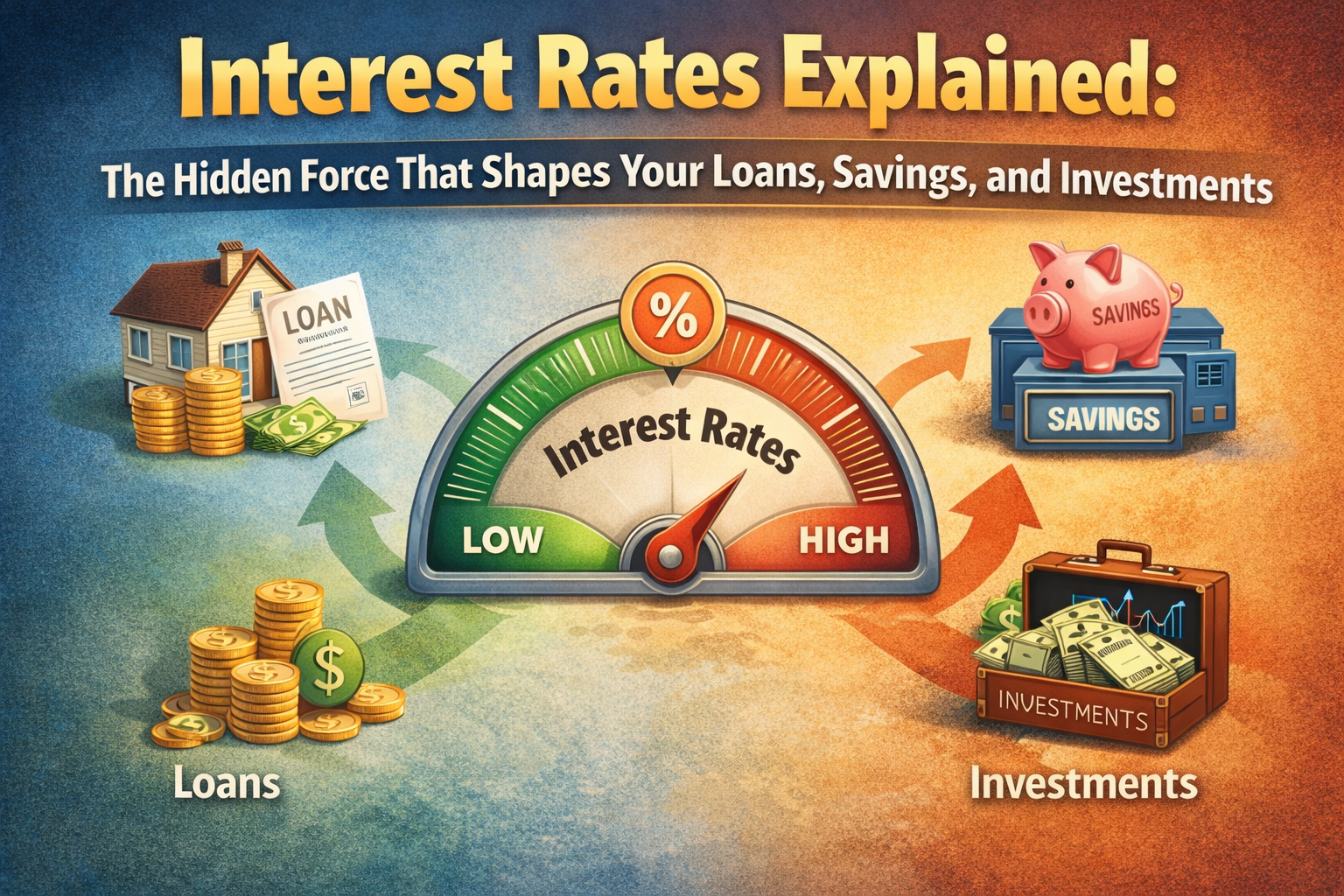
Interest rates explained in simple terms. Learn how interest rates affect loans, savings, mortgages, and investments—and how to make smarter financial decisions.
Introduction
If you’ve ever taken a loan, opened a savings account, or thought about investing money, you’ve already encountered interest rates—even if you didn’t pay much attention to them at the time.
Interest rates quietly influence almost every part of our financial lives. They determine how expensive it is to borrow money, how much you earn on savings, and even how strong or weak the economy feels.
For example, when interest rates rise, home loans and car loans become more expensive. When they fall, borrowing becomes cheaper, but savings accounts often earn less.
In simple terms, interest rates represent the cost of borrowing money or the reward for saving it. They might look like small percentages on paper, but their impact on personal finance, business decisions, and global economies is enormous.
Understanding how interest rates work can help you make smarter choices—whether you’re applying for a mortgage, investing for the future, or simply deciding where to keep your savings.
Let’s break down how they actually work and why they matter so much.
What Are Interest Rates?
An interest rate is the percentage charged by a lender when someone borrows money, or the percentage earned when someone saves or invests money.
Think of it as the price of money.
For example:
- If you borrow ₹1,00,000 at a 10% interest rate, you’ll pay ₹10,000 per year in interest.
- If you deposit ₹1,00,000 in a savings account earning 5% interest, you’ll earn ₹5,000 annually.
Interest rates apply to many financial products, including:
- Personal loans
- Home loans (mortgages)
- Credit cards
- Savings accounts
- Bonds and fixed deposits
For a detailed overview, you can explore the concept further on Wikipedia:
https://en.wikipedia.org/wiki/Interest_rate
Why Interest Rates Exist
At its core, interest compensates lenders for three main factors:
1. Time Value of Money
Money today is worth more than money tomorrow.
Why? Because today’s money can be invested to generate returns.
Interest rates compensate lenders for delaying their use of money.
2. Inflation Risk
If inflation rises, the value of money declines.
Lenders charge interest partly to protect themselves from the loss of purchasing power over time.
For example, if inflation averages 6%, lending money at 2% interest would result in a loss in real value.
3. Credit Risk
Not every borrower repays their debt.
Interest rates often include a risk premium based on the borrower’s creditworthiness.
Borrowers with higher risk typically pay higher rates.
Types of Interest Rates
Interest rates come in different forms depending on the financial product.
Fixed Interest Rates
A fixed interest rate remains the same for the entire duration of a loan.
Example:
- A 20-year mortgage with a fixed 7% interest rate
- Your monthly payments stay predictable
This option is popular for long-term stability.
Variable (Floating) Interest Rates
A variable interest rate changes over time depending on market conditions.
The rate may increase or decrease based on central bank policies and economic conditions.
These loans often start with lower rates but carry more uncertainty.
Simple Interest
Simple interest is calculated only on the original principal amount.
Formula:
Principal × Interest Rate × Time
This method is often used in short-term loans.
Compound Interest
Compound interest is calculated on the principal plus accumulated interest.
In other words, you earn interest on your interest.
Over time, this creates powerful growth for investments and savings.
The concept of compound interest is widely discussed by economists and institutions like Investopedia, which provides deeper insights:
https://www.investopedia.com/terms/c/compoundinterest.asp
How Interest Rates Affect Your Daily Financial Life
Interest rates might seem abstract, but they influence everyday financial decisions.
Let’s look at a few examples.
1. Loans Become More or Less Expensive
When interest rates rise:
- Home loans become more costly
- Car loans require larger payments
- Credit card balances grow faster
When rates fall:
- Borrowing becomes cheaper
- Consumers tend to spend more
- Businesses invest more
This is why interest rate changes often affect the housing market quickly.
2. Savings and Fixed Deposits
Higher interest rates generally benefit savers.
Banks offer better returns on:
- Savings accounts
- Fixed deposits
- Certificates of deposit
When rates fall, these returns shrink.
3. Stock Market Movements
Interest rates also influence the stock market.
Generally:
- Lower interest rates encourage investment in stocks
- Higher interest rates make safer investments like bonds more attractive
Investors constantly watch central bank policies for clues about future rate changes.
Who Controls Interest Rates?
Interest rates are heavily influenced by central banks.
These institutions manage monetary policy to stabilize economies.
Examples include:
- The Federal Reserve (USA)
- The European Central Bank
- The Reserve Bank of India (RBI)
Central banks adjust benchmark interest rates, which influence borrowing costs across the entire financial system.
When inflation rises too quickly, central banks often increase rates to slow spending.
When economies slow down, they may lower rates to encourage borrowing and investment.
Interest Rates and Inflation: A Powerful Relationship
Interest rates and inflation are closely connected.
When inflation rises:
- Central banks often increase interest rates
- Borrowing becomes expensive
- Spending slows down
This helps reduce inflationary pressure.
On the other hand, if inflation is too low, central banks may cut rates to stimulate economic activity.
This balancing act is one of the biggest challenges in economic policy.
Real vs Nominal Interest Rates
Understanding the difference between real and nominal interest rates helps investors evaluate actual returns.
Nominal Interest Rate
This is the rate quoted by banks and financial institutions.
Example: 7% on a savings account.
Real Interest Rate
Real interest rates account for inflation.
Formula:
Real Interest Rate = Nominal Rate – Inflation
If:
- Nominal rate = 7%
- Inflation = 5%
Your real return is only 2%.
This is why inflation-adjusted returns matter for long-term investing.
Smart Financial Decisions in a Changing Interest Rate Environment
Interest rates constantly change, so smart financial planning requires adaptability.
Here are a few practical strategies.
1. Lock Fixed Rates When Borrowing Long Term
If interest rates are historically low, fixed-rate loans can provide long-term savings.
This protects borrowers from future increases.
2. Pay Down High-Interest Debt Quickly
Credit cards often carry extremely high interest rates.
Paying them off early prevents interest from snowballing.
3. Diversify Investments
Interest rate changes affect asset classes differently.
A balanced portfolio may include:
- Stocks
- Bonds
- Real estate
- Commodities
Diversification reduces exposure to sudden economic shifts.
4. Monitor Central Bank Announcements
Major interest rate changes usually follow central bank policy meetings.
Staying informed helps investors anticipate market trends.
Why Interest Rates Matter More Than Most People Realize
Interest rates influence far more than personal loans and savings accounts.
They shape the entire financial ecosystem.
They affect:
- Housing markets
- Business investments
- Government borrowing
- Currency strength
- Stock market valuations
When central banks adjust interest rates, ripple effects spread through economies worldwide.
That’s why economists, investors, and policymakers watch them so closely.
Conclusion
Interest rates may look like simple percentages, but they carry enormous influence over financial decisions and economic trends.
They determine how expensive it is to borrow, how rewarding it is to save, and how quickly economies grow.
By understanding how interest rates work, you can make smarter choices—whether you’re taking a loan, investing for retirement, or planning long-term financial goals.
The more aware you are of how interest rates affect your money, the better prepared you’ll be to navigate changing economic conditions.
Frequently Asked Questions (FAQ)
What is an interest rate in simple terms?
An interest rate is the percentage charged when borrowing money or earned when saving or investing money.
Why do interest rates change?
Interest rates change primarily due to central bank policies, inflation levels, economic growth, and demand for borrowing.
How do interest rates affect loans?
Higher interest rates increase borrowing costs, leading to larger loan payments. Lower rates make loans more affordable.
What is the difference between simple and compound interest?
Simple interest is calculated only on the original principal, while compound interest is calculated on both the principal and accumulated interest.
How do interest rates affect the stock market?
Lower interest rates usually encourage stock investments because borrowing is cheaper, while higher rates may shift investors toward safer assets like bonds.
