
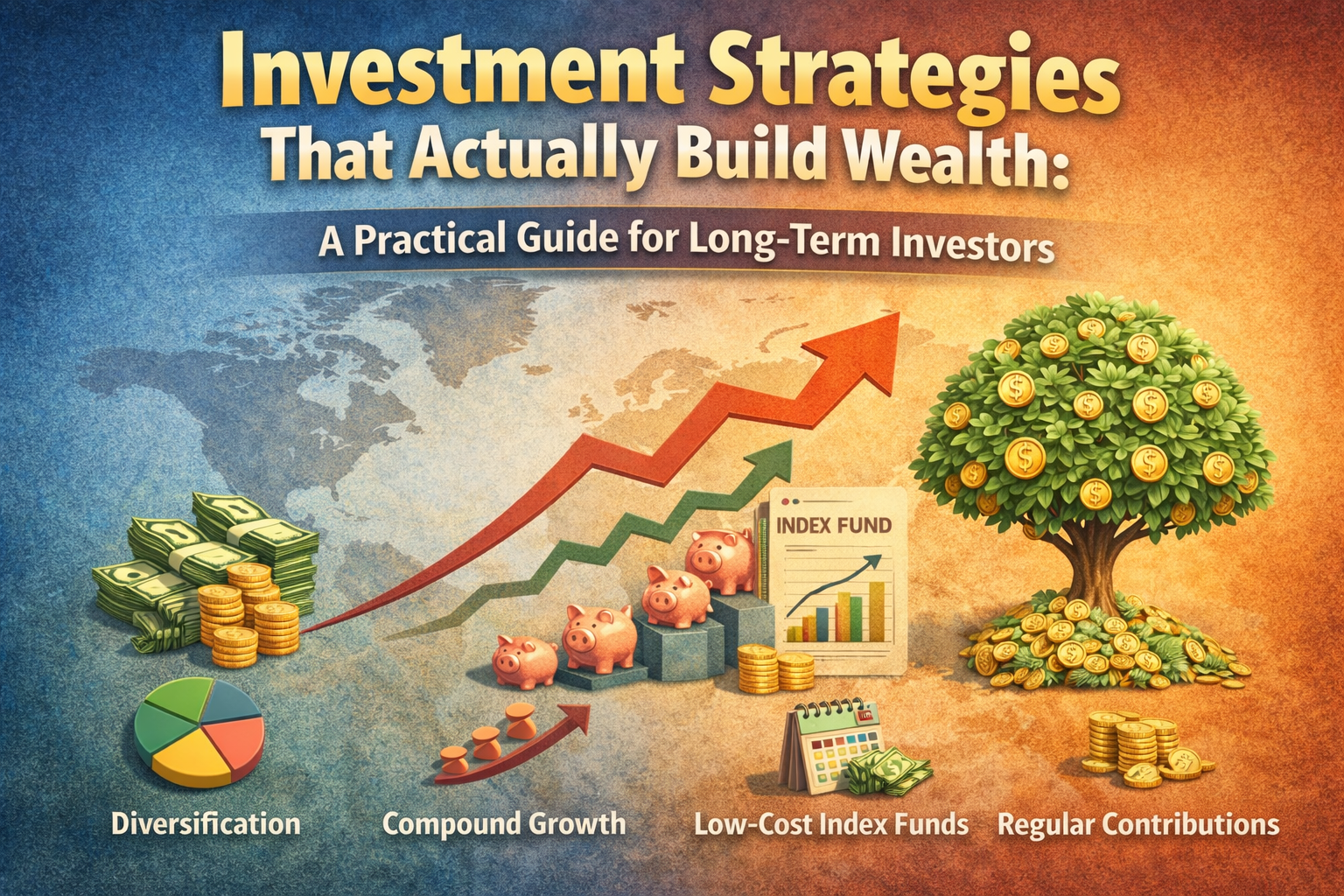
Discover powerful investment strategies to grow wealth through stocks, bonds, real estate, and diversified portfolios. Learn smart investing for long-term financial success.
Introduction
Most people know they should invest. The real challenge is figuring out how.
Should you buy stocks? Invest in real estate? Hold bonds for stability? Follow a long-term strategy or try to beat the market?
These questions lead many beginners down a confusing path. The truth is, successful investing isn’t about chasing the hottest stock or reacting to daily market news. Instead, it’s about choosing the right investment strategies and sticking with them over time.
Investment strategies are structured approaches used by individuals and institutions to grow wealth through assets like stocks, bonds, real estate, and other financial instruments. Some strategies focus on long-term growth, others aim for stable income, and some try to balance both.
The good news? You don’t need to be a Wall Street expert to use proven investment strategies. Many of the most successful approaches are surprisingly simple and built around patience, diversification, and discipline.
Let’s explore the strategies investors use to build wealth steadily over time.
What Are Investment Strategies?
At its core, an investment strategy is a plan that guides how you allocate money across different assets to achieve financial goals.
A good strategy considers:
- Risk tolerance
- Investment timeline
- Expected return
- Market conditions
- Diversification
For example:
- A 25-year-old investor saving for retirement may focus heavily on stocks for long-term growth.
- Someone nearing retirement may prefer bonds and dividend stocks for stability.
The key is alignment between your goals and the strategy you follow.
For a deeper explanation of investment principles, you can explore this resource from the U.S. Securities and Exchange Commission:
https://www.investor.gov/introduction-investing
Why Having an Investment Strategy Matters
Many people invest without a clear strategy. They buy assets randomly based on news headlines, social media tips, or short-term hype.
This approach often leads to emotional decisions.
A well-defined strategy helps you:
- Stay disciplined during market volatility
- Avoid panic selling during downturns
- Focus on long-term wealth building
- Manage risk effectively
Markets naturally fluctuate. A strategy provides a framework for consistency, which is often the biggest advantage long-term investors have.
Popular Investment Strategies Used by Successful Investors
Different strategies work for different investors. Below are some of the most widely used approaches in personal finance and institutional investing.
Long-Term Buy and Hold Strategy
The buy and hold strategy is one of the simplest and most effective investment strategies.
The idea is straightforward:
Buy strong assets and hold them for many years, allowing compounding and economic growth to work in your favor.
This strategy is commonly applied to:
- Index funds
- Blue-chip stocks
- Exchange-traded funds (ETFs)
Legendary investors often emphasize patience and long-term thinking. Over decades, markets historically trend upward despite short-term volatility.
This concept is explained in more detail here:
https://en.wikipedia.org/wiki/Buy_and_hold
Value Investing
Value investing focuses on buying undervalued stocks that trade below their intrinsic value.
Investors search for companies that:
- Have strong fundamentals
- Generate steady earnings
- Are temporarily undervalued by the market
The expectation is that the market will eventually recognize the company’s true value.
Key characteristics of value investing:
- Focus on financial analysis
- Long investment horizons
- Patience during market cycles
Many long-term investors prefer this strategy because it emphasizes fundamentals rather than speculation.
Growth Investing
Growth investing targets companies expected to grow faster than the overall market.
These companies typically reinvest profits into expansion rather than paying dividends.
Growth investors look for businesses with:
- Rapid revenue growth
- Innovative products or services
- Expanding market share
Technology companies often fall into this category.
The trade-off is higher volatility, but the potential rewards can also be significant.
Dividend Investing
Some investors prefer steady income rather than relying purely on capital gains.
Dividend investing focuses on companies that regularly distribute profits to shareholders.
Benefits of dividend investing include:
- Passive income streams
- Stability during market downturns
- Reinvestment opportunities through dividend reinvestment plans (DRIPs)
Dividend-paying companies are often well-established businesses with strong cash flow.
Real Estate Investment Strategy
Real estate has long been considered a reliable wealth-building asset.
Investors use several approaches, including:
- Rental property investing
- Real estate investment trusts (REITs)
- Property appreciation strategies
Real estate offers two major advantages:
- Rental income
- Long-term property value appreciation
It also provides diversification outside traditional financial markets.
Index Fund Investing
Index investing has become extremely popular in recent years.
Instead of trying to beat the market, investors simply track the performance of a market index.
Examples include:
- S&P 500 index funds
- Total market index funds
- Global market ETFs
Benefits include:
- Low management fees
- Broad diversification
- Reduced risk compared to individual stock picking
Many financial advisors recommend index investing for beginners because of its simplicity.
Dollar-Cost Averaging
Dollar-cost averaging is a strategy that involves investing a fixed amount of money at regular intervals.
For example:
Invest ₹10,000 every month regardless of market conditions.
This approach offers two major advantages:
- Reduces the impact of market volatility
- Removes emotional decision-making
Over time, investors buy more shares when prices are low and fewer when prices are high.
Asset Allocation and Diversification
No investment strategy is complete without diversification.
Diversification spreads investments across multiple asset classes to reduce overall risk.
A diversified portfolio might include:
- Stocks for growth
- Bonds for stability
- Real estate for income and diversification
- Commodities like gold as a hedge
Asset allocation is one of the most important decisions in long-term investing.
Studies show that portfolio allocation often influences returns more than individual asset selection.
Choosing the Right Investment Strategy
The best investment strategies are the ones that match your personal financial situation.
Here are a few key factors to consider.
Risk Tolerance
How comfortable are you with market fluctuations?
Aggressive investors may prefer growth stocks, while conservative investors often lean toward bonds.
Investment Time Horizon
Your timeline matters.
- Long-term investors can tolerate more volatility
- Short-term investors usually require stability
Financial Goals
Different goals require different strategies.
Examples:
- Retirement planning
- Building passive income
- Wealth preservation
- Saving for major purchases
Common Investment Mistakes to Avoid
Even good strategies fail when investors make emotional or impulsive decisions.
Some common mistakes include:
- Trying to time the market
- Following hype or speculation
- Lack of diversification
- Frequent buying and selling
- Ignoring long-term planning
Successful investing often comes down to consistency rather than complexity.
How Institutions Use Investment Strategies
Large institutions such as pension funds, insurance companies, and hedge funds also rely on structured investment strategies.
They typically use combinations of:
- Asset allocation models
- Risk management frameworks
- Portfolio rebalancing strategies
While individual investors may not have access to advanced tools, many core principles remain the same.
Diversification, discipline, and long-term thinking remain universal.
Conclusion
Building wealth through investing isn’t about luck or market timing. It’s about choosing reliable investment strategies and allowing them to work over time.
Whether you prefer long-term index investing, dividend income, real estate ownership, or value investing, the most important factor is consistency.
Markets will rise and fall, but disciplined investors who stay focused on long-term strategies often benefit the most.
Start with a clear plan, diversify wisely, and give your investments time to grow. Over the years, those small, steady decisions can turn into meaningful financial progress.
Frequently Asked Questions (FAQ)
What are investment strategies?
Investment strategies are structured methods used to allocate money across assets like stocks, bonds, and real estate in order to grow wealth over time.
What is the best investment strategy for beginners?
Many beginners start with index fund investing and dollar-cost averaging because they offer diversification, simplicity, and lower risk compared to individual stock picking.
Why is diversification important in investing?
Diversification spreads investments across different assets, reducing the impact of losses from any single investment.
How long should you hold investments?
Many successful investors hold investments for years or decades. Long-term strategies allow compounding and market growth to work in your favor.
What is dollar-cost averaging?
Dollar-cost averaging is the practice of investing a fixed amount regularly regardless of market prices, helping reduce volatility and emotional investing.
Can investment strategies guarantee profits?
No investment strategy guarantees profits. However, disciplined long-term strategies can significantly improve the chances of achieving consistent financial growth.
