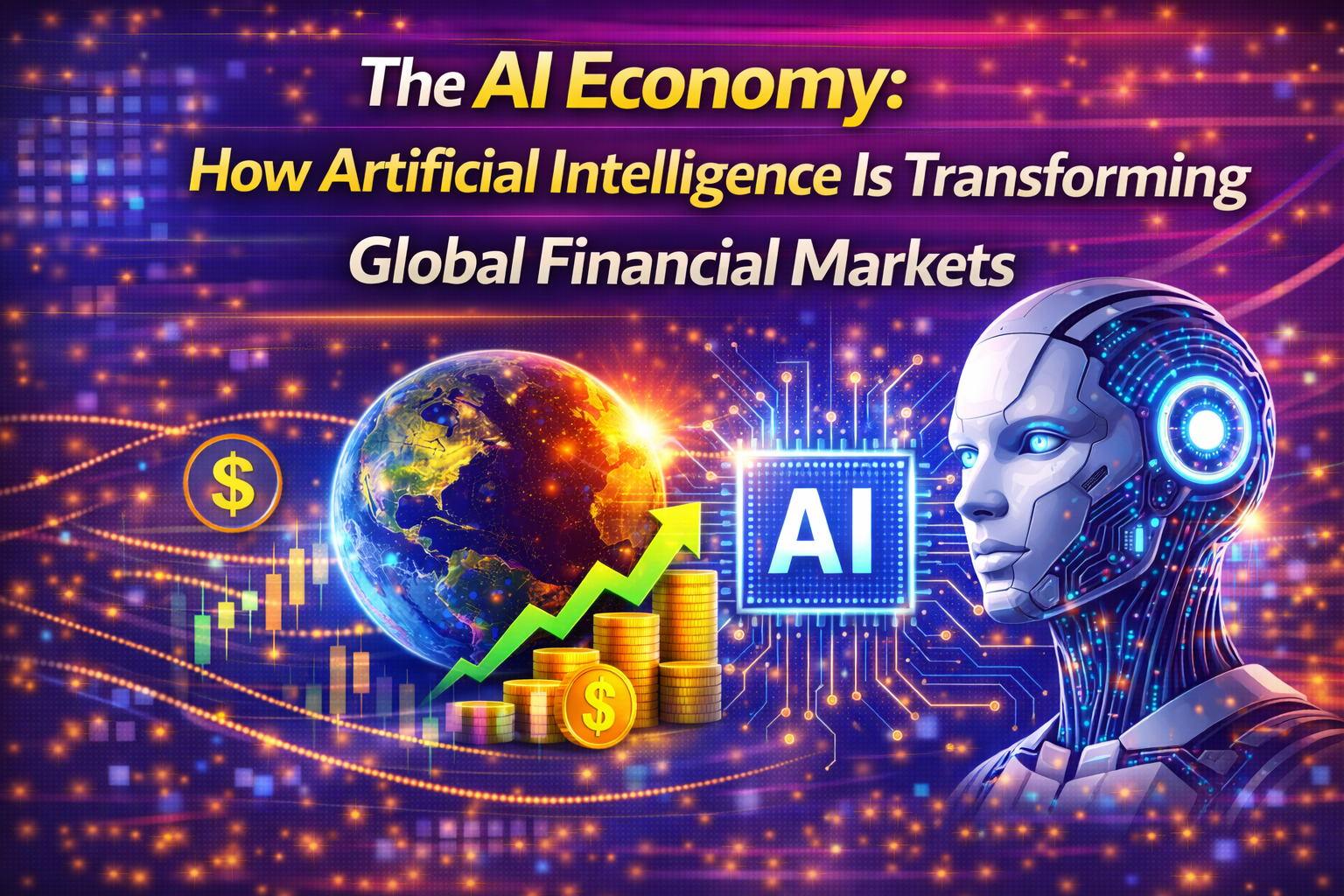
The AI Economy: How Artificial Intelligence Is Transforming Global Financial Markets : Discover how the AI economy is transforming global financial markets through algorithmic trading, predictive analytics, fintech innovation, and smarter investment strategies.
Introduction Of The AI Economy: How Artificial Intelligence Is Transforming Global Financial Markets
A decade ago, most investors relied on research reports, financial news, and experience to guide their investment decisions. Markets moved quickly, but human analysis still sat at the center of finance.
That balance has changed dramatically.
Today, a growing share of financial activity is driven by algorithms capable of analyzing massive datasets in seconds. These systems detect patterns, manage risk, and execute trades faster than any human trader could.
Welcome to the AI economy—a new phase of global finance where advanced data analysis, machine learning models, and automated systems are reshaping how markets operate.
From hedge funds to retail trading apps, artificial intelligence is transforming global financial markets in ways that are only beginning to unfold. Investors, institutions, and regulators are all trying to understand what this shift means for the future of money.
What Is the AI Economy?
The AI economy refers to the growing role of advanced computational systems in economic activity, financial decision-making, and investment strategies.
In finance, this transformation includes technologies that analyze large volumes of data to identify trends, automate processes, and improve forecasting.
According to the <a href=”https://en.wikipedia.org/wiki/Artificial_intelligence” target=”_blank”>artificial intelligence</a> framework, modern systems use machine learning algorithms that can improve performance by learning from new data.
Within financial markets, these systems help institutions: The AI Economy: How Artificial Intelligence Is Transforming Global Financial Markets
- Process vast financial datasets
- Predict market movements
- Optimize trading strategies
- Improve fraud detection
- Enhance portfolio management
As financial markets generate enormous amounts of data each day, advanced analytical tools have become increasingly valuable.
Why Financial Markets Are Embracing AI
The rapid growth of the AI economy within financial markets is driven by several practical advantages : The AI Economy: How Artificial Intelligence Is Transforming Global Financial Markets
1. Speed and Data Processing
Financial markets produce extraordinary amounts of information.
Stock prices, economic indicators, earnings reports, geopolitical developments, and market sentiment all influence investment decisions.
AI-powered systems can analyze this information in real time.
Instead of manually reviewing thousands of data points, algorithms can process millions instantly.
This capability allows institutions to respond to market changes far faster than traditional analysis methods : The AI Economy: How Artificial Intelligence Is Transforming Global Financial Markets
2. Predictive Market Insights
Machine learning models excel at identifying subtle patterns in historical market data.
These patterns can help investors forecast potential market trends.
Examples include: The AI Economy: How Artificial Intelligence Is Transforming Global Financial Markets
- Detecting unusual trading activity
- Forecasting volatility changes
- Identifying momentum shifts in asset prices
While predictions are never perfect, advanced analytics provide a powerful decision-making advantage.
3. Automated Trading Systems
One of the most visible impacts of artificial intelligence in finance is the rise of algorithmic trading.
Algorithmic trading systems automatically execute trades based on pre-programmed rules and market signals.
These systems now account for a significant share of trading volume in global markets.
Institutions use automated trading to: The AI Economy: How Artificial Intelligence Is Transforming Global Financial Markets
- Execute large trades efficiently
- Reduce market impact
- Respond instantly to price movements
Organizations such as the <a href=”https://www.sec.gov/education/capitalmarkets/algorithmic-trading” target=”_blank”>U.S. Securities and Exchange Commission</a> study how algorithmic systems influence market structure and liquidity.
Key Areas Where AI Is Transforming Financial Markets
Artificial intelligence is influencing nearly every corner of the financial industry.
1. Portfolio Management
Investment managers are increasingly using machine learning models to improve portfolio allocation.
These tools analyze factors such as: The AI Economy: How Artificial Intelligence Is Transforming Global Financial Markets
- Economic indicators
- market volatility
- historical performance
- risk correlations
The goal is to construct portfolios that maximize returns while controlling risk exposure.
Some investment funds now operate almost entirely through data-driven decision systems.
2. Risk Management
Risk management has always been central to financial institutions.
Advanced analytics allows firms to identify potential risks earlier and respond more effectively.
For example, machine learning systems can monitor: The AI Economy: How Artificial Intelligence Is Transforming Global Financial Markets
- credit risk patterns
- liquidity stress signals
- market instability indicators
This capability helps financial institutions maintain stability during volatile market conditions.
3. Fraud Detection and Security
Financial fraud remains a major concern across global banking systems.
AI-based fraud detection tools analyze transaction patterns to identify suspicious activity.
These systems can detect anomalies such as: The AI Economy: How Artificial Intelligence Is Transforming Global Financial Markets
- unusual payment patterns
- abnormal account behavior
- potential identity theft
Because these systems continuously learn from new data, they become more accurate over time.
4. Retail Investing Platforms
Retail investors are also benefiting from advanced financial technology.
Many investment platforms now include automated portfolio tools that provide:
- personalized investment recommendations
- portfolio rebalancing
- tax optimization strategies
These services were previously available only through professional financial advisors.
5. Market Sentiment Analysis
Another fascinating application involves analyzing investor sentiment.
Machine learning tools scan news reports, financial commentary, and social media discussions to measure market sentiment.
If a sudden shift in investor sentiment occurs, trading strategies can adjust accordingly.
This approach adds a new dimension to market analysis.
Real-World Examples of the AI Economy in Finance
The influence of artificial intelligence on financial markets is already visible.
Consider a few examples : The AI Economy: How Artificial Intelligence Is Transforming Global Financial Markets
Quantitative Hedge Funds
Many hedge funds now rely heavily on quantitative trading strategies.
These funds analyze vast datasets—from economic reports to satellite imagery—to identify investment opportunities.
High-Frequency Trading Firms
High-frequency trading firms use advanced algorithms to execute thousands of trades per second.
Their goal is to profit from small price differences that appear across markets.
Digital Investment Advisors
Automated investment platforms provide diversified portfolios based on user goals and risk tolerance.
These systems continuously monitor portfolios and adjust allocations when market conditions change.
Investment Opportunities in the AI Economy
The expansion of artificial intelligence in financial markets has created new investment themes.
Several sectors may benefit from this transformation.
Semiconductor Industry
AI systems require powerful computing hardware.
Demand for advanced semiconductor chips has surged as AI applications expand.
Cloud Computing Infrastructure
Cloud computing platforms provide the processing power needed to analyze massive datasets.
Many financial institutions rely on cloud services to run advanced analytics models.
Data Analytics Firms
Companies specializing in financial data analytics and predictive modeling are becoming increasingly important.
Their insights help investors interpret complex market signals.
Fintech Innovation
Fintech companies are integrating advanced analytical tools into financial services, improving everything from payment systems to credit scoring.
Risks and Challenges in the AI Economy
Despite its benefits, the growing use of artificial intelligence in financial markets also presents challenges : The AI Economy: How Artificial Intelligence Is Transforming Global Financial Markets
Market Volatility
Automated trading systems can react simultaneously to market signals.
This rapid response can sometimes amplify market volatility.
Model Risk
Machine learning models depend heavily on historical data.
Unexpected economic events can disrupt patterns that models rely on.
Regulatory Oversight
Financial regulators must adapt to new technologies that influence market behavior.
Ensuring transparency and stability remains a key priority.
The Future of the AI Economy in Finance
Looking ahead, the influence of advanced analytics on global financial markets will likely continue expanding.
Several trends are worth watching.
1. Smarter Investment Algorithms
Investment systems will continue improving as computing power and data availability increase.
2. Integration With Financial Services
Advanced analytics will likely become standard across banking, insurance, asset management, and trading.
3. Real-Time Economic Analysis
Financial institutions may soon analyze economic indicators in real time, improving market forecasts.
4. Collaboration Between Humans and Machines
Rather than replacing financial professionals, advanced analytics tools will likely enhance human decision-making.
Experienced analysts will still play a crucial role in interpreting complex financial environments.
Conclusion
The AI economy is reshaping how global financial markets operate.
From algorithmic trading and predictive analytics to automated portfolio management, advanced computational tools are transforming investment strategies and financial services.
While challenges remain—including regulatory oversight and market stability—the long-term impact of artificial intelligence on finance appears profound.
Markets have always evolved alongside technology. The rise of intelligent data-driven systems simply represents the next stage in that evolution.
For investors and institutions alike, understanding how artificial intelligence is transforming global financial markets may offer valuable insights into the future of global finance.
Frequently Asked Questions (FAQ)
What is the AI economy in finance?
The AI economy refers to the increasing use of artificial intelligence technologies in financial markets, including trading algorithms, predictive analytics, fraud detection systems, and automated investment platforms.
How does AI affect stock market trading?
AI systems analyze large amounts of financial data and execute trades automatically based on market signals, allowing faster responses to price movements and trends.
What is algorithmic trading?
Algorithmic trading uses computer programs to execute trades automatically based on predefined rules and market conditions.
Can AI predict financial markets accurately?
AI can identify patterns and trends in financial data, but markets remain unpredictable. These systems improve forecasting but cannot guarantee accurate predictions.
What industries benefit from the AI economy?
Industries benefiting from the AI economy include semiconductor manufacturing, cloud computing infrastructure, financial data analytics firms, and fintech companies.
