
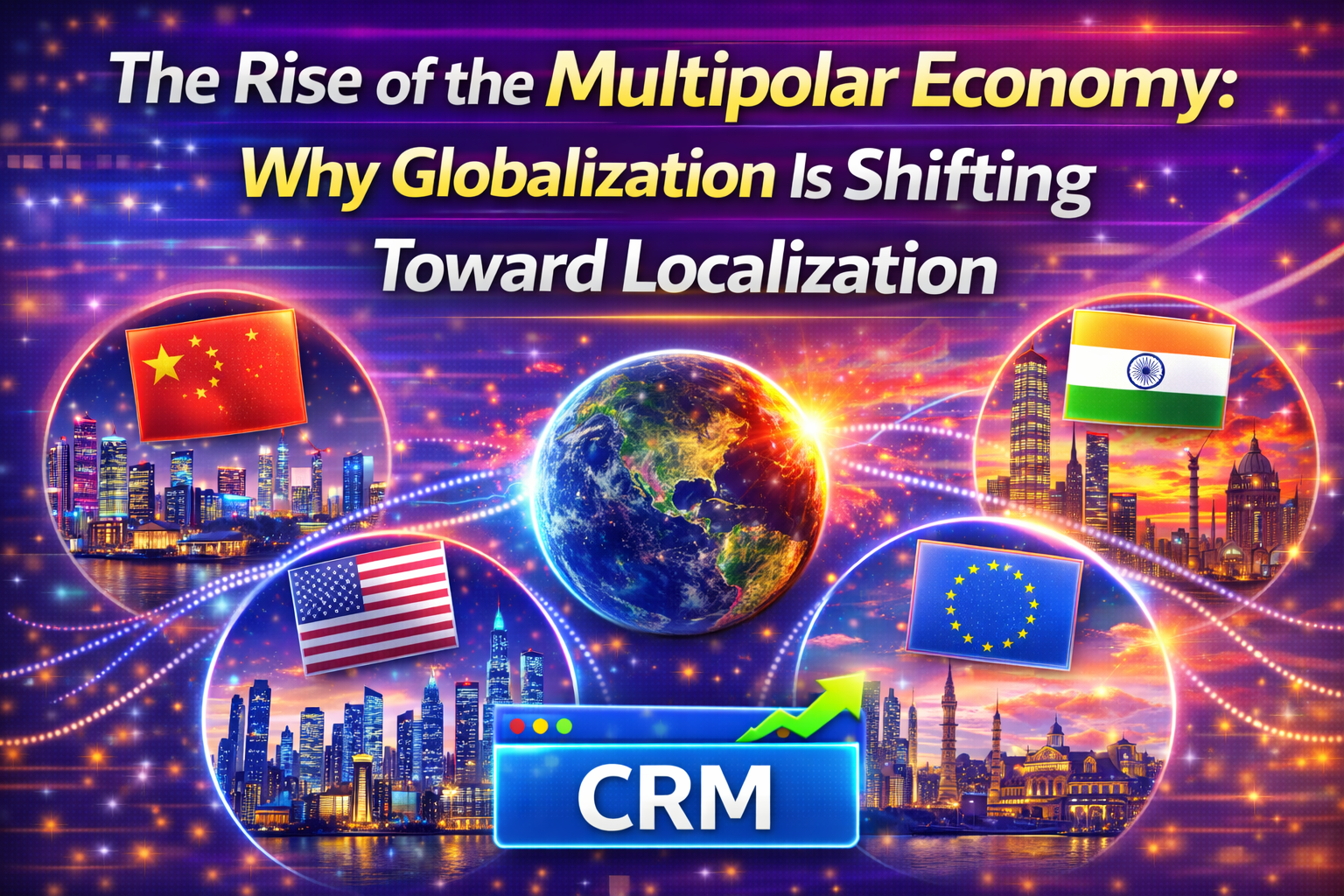
The Rise of the Multipolar Economy: Why Globalization Is Shifting Toward Localization : The multipolar economy is reshaping globalization as nations prioritize supply chain security, critical minerals, and regional trade. What it means for investors.
Introduction Of The Rise of the Multipolar Economy: Why Globalization Is Shifting Toward Localization
For decades, globalization followed a simple rule: produce goods wherever it was cheapest and ship them around the world. That formula helped lower costs, boost corporate profits, and create the interconnected global economy we know today.
But something has changed.
Governments and businesses are no longer obsessed with pure efficiency. Instead, they’re asking a different question: What happens if the supply chain breaks?
From semiconductor shortages to geopolitical tensions and trade wars, recent events exposed how fragile global supply networks can be. As a result, the world is quietly shifting toward what economists call a multipolar economy — a system where economic power is distributed across several regional centers rather than dominated by a single global network.
In practical terms, globalization isn’t disappearing. It’s evolving. Countries are building regional trade alliances, protecting critical minerals, and reshoring strategic industries.
For investors, businesses, and policymakers, this shift may define the next decade of global finance.
What Is a Multipolar Economy?
A multipolar economy describes a world where economic influence is spread across multiple regions rather than concentrated in one dominant center : The Rise of the Multipolar Economy: Why Globalization Is Shifting Toward Localization
Instead of a single global production network, we now see several powerful economic hubs emerging: The Rise of the Multipolar Economy: Why Globalization Is Shifting Toward Localization
- North America
- Europe
- China and East Asia
- India and South Asia
- The Middle East
- Parts of Africa and Latin America
Each region is strengthening its own supply chains, trade relationships, and industrial capacity.
You can see this shift in institutions like the <a href=”https://en.wikipedia.org/wiki/World_Trade_Organization” target=”_blank”>World Trade Organization</a>, which historically promoted global trade liberalization. While global trade still exists, governments are increasingly prioritizing national resilience over maximum efficiency.
In other words, economic security is becoming just as important as economic growth.
Why Globalization Is Shifting Toward Localization
The move toward a multipolar economy didn’t happen overnight. Several forces pushed governments and corporations to rethink the old globalization model. : The Rise of the Multipolar Economy : Why Globalization Is Shifting Toward Localization
1. Supply Chain Disruptions
The pandemic revealed a painful truth: many industries depend heavily on a handful of global suppliers : The Rise of the Multipolar Economy: Why Globalization Is Shifting Toward Localization
When factories shut down or shipping stalled, entire industries were paralyzed : The Rise of the Multipolar Economy: Why Globalization Is Shifting Toward Localization
A few examples:
- Auto manufacturers halted production due to semiconductor shortages
- Pharmaceutical companies faced shortages of key ingredients
- Consumer electronics companies struggled with component delays
These disruptions forced companies to rethink their dependence on distant manufacturing hubs.
2. Geopolitical Competition
Global economic relationships are increasingly shaped by political tensions.
The <a href=”https://en.wikipedia.org/wiki/China%E2%80%93United_States_trade_war” target=”_blank”>U.S.–China trade conflict</a> highlighted how strategic industries can become geopolitical leverage.
Governments now see supply chains as a national security issue, particularly in sectors such as:
- Semiconductors
- Artificial intelligence
- Rare earth minerals
- Energy infrastructure
That’s why many countries are investing heavily in domestic production capabilities.
3. Control of Critical Minerals
Critical minerals have become the new oil of the 21st century.
Materials such as lithium, cobalt, and rare earth elements are essential for technologies like:
- Electric vehicles
- Renewable energy systems
- Smartphones
- Advanced military equipment
Countries are scrambling to secure reliable access to these resources.
According to the <a href=”https://www.iea.org/reports/the-role-of-critical-minerals-in-clean-energy-transitions” target=”_blank”>International Energy Agency</a>, demand for critical minerals used in clean energy technologies could grow several times over in the coming decades.
This has sparked a race for resource independence and regional supply chains.
The Rise of Regional Trade Blocs
As globalization fragments, regional trade agreements are becoming more important.
Instead of relying on a fully global market, countries are strengthening economic partnerships within their regions.
Some major examples include:
North America
The USMCA (United States–Mexico–Canada Agreement) has reinforced supply chains across North America, particularly in manufacturing and automotive sectors.
Many companies are shifting production from Asia to Mexico — a trend often called nearshoring.
Europe
The European Union continues to deepen internal trade and industrial policy coordination.
Recent initiatives focus on:
- Semiconductor manufacturing
- Renewable energy independence
- Strategic technology development
Asia-Pacific
Regional trade agreements like the Regional Comprehensive Economic Partnership (RCEP) are strengthening economic integration across Asia.
This includes major economies such as China, Japan, South Korea, and Australia.
Emerging South-South Trade
Trade among developing economies is growing rapidly, particularly between:
- India and the Middle East
- China and Africa
- Latin America and Asia
These partnerships reflect a broader redistribution of global economic power.
How Businesses Are Adapting
Multinational companies are quietly redesigning their supply chains to match this new economic reality.
The old model focused on lowest cost production anywhere in the world.
The new model emphasizes resilience and diversification.
Businesses are increasingly adopting strategies like:
1. Nearshoring
Moving production closer to home markets.
Examples include:
- U.S. companies expanding factories in Mexico
- European firms investing in Eastern Europe
2. Friendshoring
Sourcing materials and components from politically aligned countries.
This reduces geopolitical risk.
3. Multi-Supplier Strategies
Instead of relying on one supplier, companies now use multiple suppliers across different regions.
While slightly more expensive, it dramatically reduces supply disruptions.
What the Multipolar Economy Means for Investors
For investors, the rise of the multipolar economy creates both risks and opportunities : The Rise of the Multipolar Economy: Why Globalization Is Shifting Toward Localization
Certain sectors may benefit significantly from the shift toward localized supply chains : The Rise of the Multipolar Economy: Why Globalization Is Shifting Toward Localization
Industries Likely to Benefit
1. Semiconductor manufacturing
Countries are pouring billions into domestic chip production.
Major semiconductor hubs are emerging in:
- United States
- Taiwan
- South Korea
- Europe
- India
2. Critical mineral mining
Demand for lithium, nickel, and rare earth metals is expected to surge.
Mining companies with stable supply sources may see long-term growth.
3. Infrastructure and logistics
Regional manufacturing requires:
- New ports
- Rail networks
- Warehousing hubs
- Energy infrastructure
These projects are often supported by government spending.
4. Defense and cybersecurity
Economic fragmentation often coincides with increased geopolitical competition.
Defense spending globally has already reached record levels.
Risks of a Multipolar Global Economy
The transition toward regionalized globalization isn’t entirely smooth.
There are several potential downsides.
Higher Costs
Localized manufacturing can be more expensive than global outsourcing.
Consumers may ultimately pay higher prices.
Fragmented Technology Standards
Different regions may develop competing technology ecosystems.
This could slow innovation or create compatibility issues.
Trade Tensions
Regional blocs sometimes compete with one another, increasing the risk of tariffs or trade restrictions.
However, many economists argue that economic resilience may outweigh these risks.
Key Trends to Watch Over the Next Decade
Several long-term trends will likely shape the multipolar economy : The Rise of the Multipolar Economy: Why Globalization Is Shifting Toward Localization
1. Strategic Industrial Policy
Governments are increasingly supporting domestic industries through subsidies and tax incentives.
2. Energy Transition
The shift toward renewable energy will reshape global resource markets.
3. Digital Infrastructure
Countries are racing to control key technologies such as:
- AI
- 5G networks
- Cloud computing
- Semiconductor fabrication
4. Emerging Market Growth
Countries like India, Indonesia, and Brazil could become major economic centers in a multipolar world.
Conclusion
The multipolar economy marks one of the most important shifts in global finance since the rise of modern globalization.
Global trade isn’t disappearing, but it is becoming more regional, more strategic, and more politically influenced.
Supply chain security, control of critical minerals, and domestic technological capability are now central priorities for governments around the world.
For businesses and investors, this shift presents both challenges and opportunities.
Understanding how globalization is evolving — rather than assuming the old model will continue forever — may be one of the most valuable financial insights of the next decade.
Frequently Asked Questions (FAQ)
What is a multipolar economy?
A multipolar economy is a global economic system where power and influence are distributed among multiple regional centers rather than dominated by a single country or economic bloc.
Why is globalization shifting toward localization?
Governments are prioritizing supply chain security, national security concerns, and control over critical technologies and resources. This has led to regional trade agreements and domestic production strategies.
What industries benefit from a multipolar economy?
Industries likely to benefit include semiconductor manufacturing, critical mineral mining, infrastructure development, defense technology, and logistics networks supporting regional supply chains.
How does a multipolar economy affect global trade?
Global trade continues but becomes more regionalized. Countries increasingly trade within strategic alliances or regional blocs rather than relying solely on global supply networks.
